Trainer
Trainer is an orchestrator class used to streamline, train, and manage the training process.
Parameters:
| Name | Type | Description | Default |
|---|---|---|---|
model
|
Module
|
Model to train. |
required |
optimizer
|
Optimizer
|
Optimizer used for parameter updates. |
required |
loss
|
Loss function used during training. |
required |
Example:
trainer = ntk.Trainer(
    model=my_model,
    optimizer=ntk.Adam(parameters=my_model.parameters()),
    loss=ntk.MeanSquaredError()
)
fit

Train the model on the provided data.
Training data may be provided as raw tensors, a Dataset, or a DataLoader. When using raw input tensors, labels must be provided through the y argument.
Parameters:
| Name | Type | Description | Default |
|---|---|---|---|
data
|
Training data. |
required | |
y
|
Training labels when using raw input tensors. |
None
|
|
epochs
|
int
|
Number of training epochs. |
1
|
batch_size
|
int
|
Number of samples per batch. |
None
|
shuffle
|
bool
|
Whether to shuffle the training data. |
None
|
drop_remainder_batch
|
bool
|
Whether to drop incomplete batches. |
None
|
validation_split
|
float
|
Fraction of training data reserved for validation. |
None
|
validation_data
|
Separate validation dataset or dataloader. |
None
|
|
verbose
|
bool
|
Whether to track progess in the terminal. Defaults to |
None
|
Returns:
| Type | Description |
|---|---|
History
|
After training has completed, a |
Example
history = trainer.fit(dataloader, epochs=100)
history.plot("loss", "val_loss)
Implementatino
trainer = ntk.Trainer(
    model=my_model,
    optimizer=ntk.Adam(parameters=my_model.parameters()),
    loss=ntk.BinaryCrossEntropy()
)

history = trainer.fit(dataloader, epochs=300)
history.plot("loss")
History Plot Output
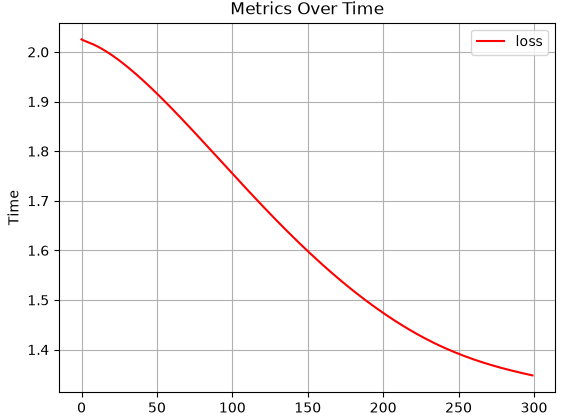
History Metrics
The History object tracks two training metrics (with more to come), loss and validation loss, which can be plotted like so:
history.plot("loss", "val_loss")